

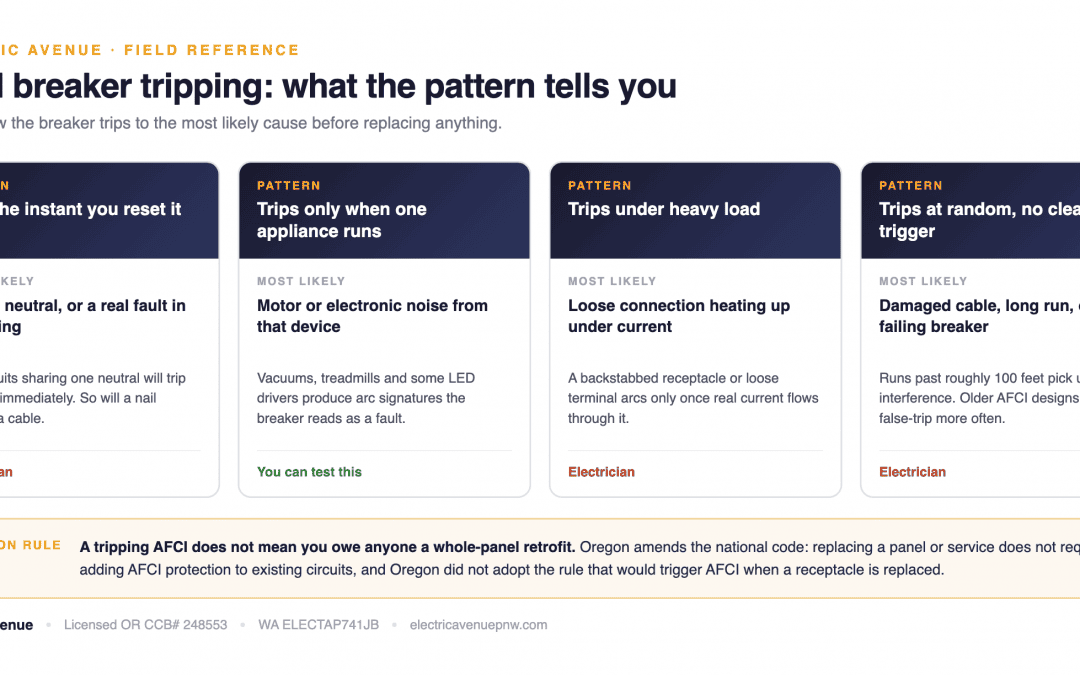
An arc-fault breaker that keeps tripping is almost always reporting something real, and the pattern of the trip tells you what. A breaker that trips the instant you reset it points somewhere very different from one that only trips when the vacuum runs. Before anyone sells you a panel full of new breakers, the trip pattern narrows the cause down to one of about five things, and two of them you can safely test yourself in ten minutes.
The second thing worth knowing before you call anyone: Oregon does not enforce the national arc-fault rules the way the rest of the country does. The state has amended them in four separate places, and one of those amendments exists specifically to deal with equipment that causes unwanted tripping. Most of what you will read about AFCI breakers online is written to the national code and is simply wrong here.
Last updated August 22, 2026
What the trip pattern tells you
Start here. How the breaker trips is the single most useful diagnostic you have, and it costs nothing.
| How it trips | Most likely cause | Who handles it |
|---|---|---|
| Trips the instant you reset it, nothing running | Shared neutral between two circuits, or a genuine fault in the cable | Electrician |
| Trips only when one appliance runs | Motor brush arcing or electronic noise from that device | You can test this |
| Trips under heavy load, fine when idle | Loose connection heating and arcing under current | Electrician |
| Trips at random with no clear trigger | Damaged cable, a very long circuit run, or a failing breaker | Electrician |
| Trips only in wet weather | Moisture intrusion at an outdoor box or fixture | Electrician |
What an AFCI actually detects, and why it is not a GFCI
People mix these up constantly, and the confusion leads to the wrong repair.
A GFCI watches for current leaking out of the circuit, usually through a person or through water. It is protecting you from electrocution.
An AFCI watches the waveform itself, looking for the electrical signature of an arc: a loose terminal sparking behind a wall, a nail driven through a cable, a cracked conductor in old insulation. It is protecting the building from fire. Arcing faults do not necessarily draw enough current to trip a standard breaker, which is exactly why arc-fault protection exists.
That sensitivity is also why AFCIs trip on things that are not faults at all. A universal motor with brushes produces an arc every time a brush passes a commutator segment, and to a breaker’s detection algorithm that can look a great deal like a failing connection.
Breaker will not stay reset?
If it trips immediately with everything unplugged, stop resetting it and have it looked at.
The five real causes
1. A shared neutral
This is the most common cause of a breaker that will not reset at all. Older wiring frequently ran two circuits sharing a single neutral conductor. A single-pole AFCI needs its own dedicated neutral landed on its neutral terminal, so the moment that breaker goes into a panel with a shared neutral, it trips immediately and every time. The fix is either a two-pole AFCI or separating the circuits. It is a wiring correction, not a defective breaker.
2. A genuine fault in the cable
A screw or nail through a cable, a staple driven too tight, rodent damage in a crawlspace, or insulation that has gone brittle with age. This is the failure mode arc-fault protection was invented to catch, and when the breaker is right, it has just saved you from a fire in a wall cavity.
3. Motor and electronic noise
Vacuum cleaners, treadmills, older power tools, some furnace blowers, and certain LED drivers and switching power supplies. These produce electrical noise that overlaps with what the breaker reads as an arc. If it trips only when one specific device runs, this is very likely your answer.
4. A long circuit run
Circuits much beyond roughly 100 feet accumulate enough electrical noise and capacitive coupling to cause unwanted trips on their own. Common in larger homes, detached garages, and shops.
5. A failing breaker
It does happen, and early AFCI designs false-tripped considerably more than current ones. But it belongs at the bottom of the list, not the top. Replacing the breaker first is the most expensive way to guess, and if the real problem is a loose connection in a wall, swapping the breaker leaves the hazard exactly where it was.
Swapping an AFCI for a standard breaker to stop the tripping removes fire protection from a circuit that has been telling you something is wrong. It is also a code violation on any circuit that requires the protection, and it will be caught at the next inspection or during a sale.
The isolation test you can safely run yourself
This requires no tools and nothing more than unplugging things.
- Unplug everything on the affected circuit. Everything, including chargers and anything with a standby light.
- Reset the breaker. If it now holds, the problem is a plugged-in device, not your wiring.
- Plug items back in one at a time, waiting a few minutes between each, and run each device rather than just leaving it plugged in.
- When the breaker trips, you have found your device.
Where to stop. If the breaker trips immediately with the circuit completely unplugged, the fault is in the fixed wiring and there is nothing further you can safely do. The same is true if you smell anything hot, see discoloration around an outlet, or find a warm faceplate. Leave the breaker off and call an electrician. Repeatedly resetting a breaker onto a real arcing fault is how wall fires start.
Worth reading alongside this: our guides on what a smoking outlet means and what flickering lights are telling you, both of which can share a root cause with arc-fault tripping.
Oregon’s four exceptions, and what you do not owe anyone
This is where national advice fails Portland homeowners, and where the money is.
Oregon does not adopt the National Electrical Code as written. It publishes amendments in Table 1-E of the Oregon Electrical Specialty Code, currently effective October 1, 2023 and amended January 1, 2026. On arc-fault protection, Oregon has changed the rules in four meaningful ways.
Exception No. 2: arc-fault protection is not required on branch circuits supplying receptacles located in hallways, kitchens or laundry areas, or on GFCI-protected receptacles installed in dining rooms.
Exception No. 3: arc-fault protection is not required for optional, dedicated outlets that supply equipment known to cause unwanted tripping of AFCI devices.
Exception No. 4: arc-fault protection is not required for branch circuits serving an appliance that is not easily moved or is fastened in place.
Read Exception No. 3 again, because it is unusual and it is directly relevant to your problem. Oregon has written the nuisance-tripping issue into the code. If a specific piece of equipment is known to cause unwanted tripping, a dedicated outlet for it does not require arc-fault protection. That is a legitimate, code-compliant solution that a lot of electricians working from the national code do not know exists here.
What a panel upgrade does not require
The other two amendments matter if anyone has quoted you an arc-fault retrofit:
- 210.12(E) Exception No. 2: replacement or upgrading of a service or panelboard shall not require that existing circuits be protected by AFCI devices.
- 210.12(E) Exception No. 1: extensions or modifications of existing circuits shall not require the installation of AFCI protection.
- 406.4(D)(4), the national rule that triggers arc-fault protection when a receptacle is replaced, is listed as not adopted by the State of Oregon.
Put plainly: replacing your panel in Oregon does not obligate you to buy arc-fault breakers for every existing circuit in the house. Neither does replacing an outlet, or extending a circuit. At current prices that difference is frequently well over a thousand dollars on a single job. If a contractor has told you the code requires it, they are quoting a code Oregon has amended. Our Portland panel upgrade cost guide covers the same ground from the pricing side.
Arc-fault protection is often a genuinely good upgrade, and on a house with old wiring we will say so. The distinction is that it should be presented to you as a choice, with a reason, and not as a requirement you have no say in.
These exceptions apply to existing circuits. New circuits and new construction still require arc-fault protection in the locations Oregon does adopt, and Oregon’s version covers 10, 15 and 20 ampere circuits. Oregon’s 2026 code edition is anticipated October 1, 2026, so verify current requirements before any new work after that date.
Why older Portland homes trip arc-faults more often
Portland’s housing stock skews old, and that changes the odds considerably. In a 1920s bungalow in Sellwood or a 1940s house in Hollywood, the wiring behind the walls has been worked on by many hands over many decades.
Three things show up repeatedly on service calls in those homes. Shared neutrals, from an era when that was normal practice. Backstabbed receptacles, where the wire was pushed into the back of a device instead of secured under the screw terminal, which loosens over time and arcs under load. And brittle insulation on conductors that have been heat-cycled for eighty years.
An arc-fault breaker installed in a house like that is often not malfunctioning. It is finding something that has been quietly wrong for a long time. Where the house still has knob and tube wiring, or has had it partially replaced, that is worth investigating on its own terms.
When tripping is dangerous and when it is merely annoying
Treat as urgent, and leave the breaker off:
- Any burning or hot plastic smell, anywhere on the circuit
- Scorching, discoloration, or melted plastic at an outlet or switch
- A faceplate or breaker that is warm or hot to the touch
- Buzzing or crackling from the panel, an outlet, or a wall
- Tripping that started right after water intrusion
Annoying rather than urgent: a breaker that holds fine except when one specific appliance runs. That still deserves a diagnosis, but it is not a same-night emergency. If you are unsure which category you are in, our guide on what counts as an electrical emergency lays out the line.
- Oregon Electrical Specialty Code, Table 1-E amendments, effective October 1, 2023, amended January 1, 2026 (Oregon Building Codes Division)
- Oregon Electrical Specialty Code adoption schedule (Oregon Building Codes Division)
- Oregon Construction Contractors Board license lookup
- Portland Permitting & Development, residential electrical permits
Frequently asked questions
Why does my AFCI breaker trip when nothing is plugged in?
A breaker that trips with the circuit completely unplugged is reporting a problem in the fixed wiring, not in an appliance. The two most common causes are a shared neutral, where two circuits use one neutral conductor and the AFCI cannot get the dedicated neutral it requires, and physical damage to a cable such as a nail or staple through the insulation. Stop resetting it and have the circuit traced.
Does replacing my electrical panel in Oregon require AFCI breakers on every circuit?
No. Oregon amends this specifically. Table 1-E, Section 210.12(E) Exception No. 2 states that replacement or upgrading of a service or panelboard shall not require that existing circuits be protected by AFCI devices. Exception No. 1 covers extensions and modifications of existing circuits. Oregon also lists 406.4(D)(4), the national rule triggering AFCI on receptacle replacement, as not adopted. Arc-fault protection can still be a worthwhile upgrade, but on existing circuits it is your choice rather than a requirement.
Can I just swap the arc-fault breaker for a regular one?
No. On any circuit that requires arc-fault protection it is a code violation, and on any circuit it removes fire protection from wiring that has been signalling a problem. It will also be flagged at inspection or during a home sale. If the tripping is caused by a known problem device, Oregon’s Exception No. 3 allows a dedicated non-AFCI outlet for equipment known to cause unwanted tripping, which is the legitimate version of what you are trying to do.
Is an AFCI the same thing as a GFCI?
No. A GFCI detects current leaking out of a circuit and protects people from electrocution. An AFCI reads the shape of the current waveform looking for the signature of an arc, and protects the building from fire. Some breakers are dual function and do both. They solve different problems and are not interchangeable.
Why does my vacuum trip the arc-fault breaker?
Vacuums with universal motors arc continuously at the motor brushes by design, and that arcing can resemble a fault to the breaker’s detection circuitry. Treadmills, older power tools and some LED drivers do the same. If the breaker holds until that one device runs, the wiring is likely fine. In Oregon a dedicated outlet for equipment known to cause unwanted tripping is a code-recognised option.
How much does it cost to diagnose an AFCI that keeps tripping?
It depends on how much of the circuit has to be traced. A trip isolated to one appliance is quick. A shared neutral or a damaged cable in a finished wall takes longer, because the work is finding the fault rather than fixing it. We quote the diagnostic before starting so there is no open-ended meter running, and we will tell you if the honest answer is that you do not need the work.
Do the same rules apply in Vancouver and Clark County?
No. Washington is a separate jurisdiction with its own electrical rules, and Oregon’s Table 1-E amendments do not apply there. Washington currently enforces the 2023 National Electrical Code, with the 2026 edition taking effect December 31, 2026. Electric Avenue is licensed in both states, Oregon CCB# 248553 and Washington ELECTAP741JB, so the correct rules get applied on either side of the river.
Breaker still tripping? Let’s find out why.
We trace the fault before we replace anything, and we will tell you plainly when Oregon’s code does not require the work someone else quoted you. Licensed in Oregon (CCB# 248553) and Washington (ELECTAP741JB), 275+ five-star reviews, veteran, woman and minority owned.