
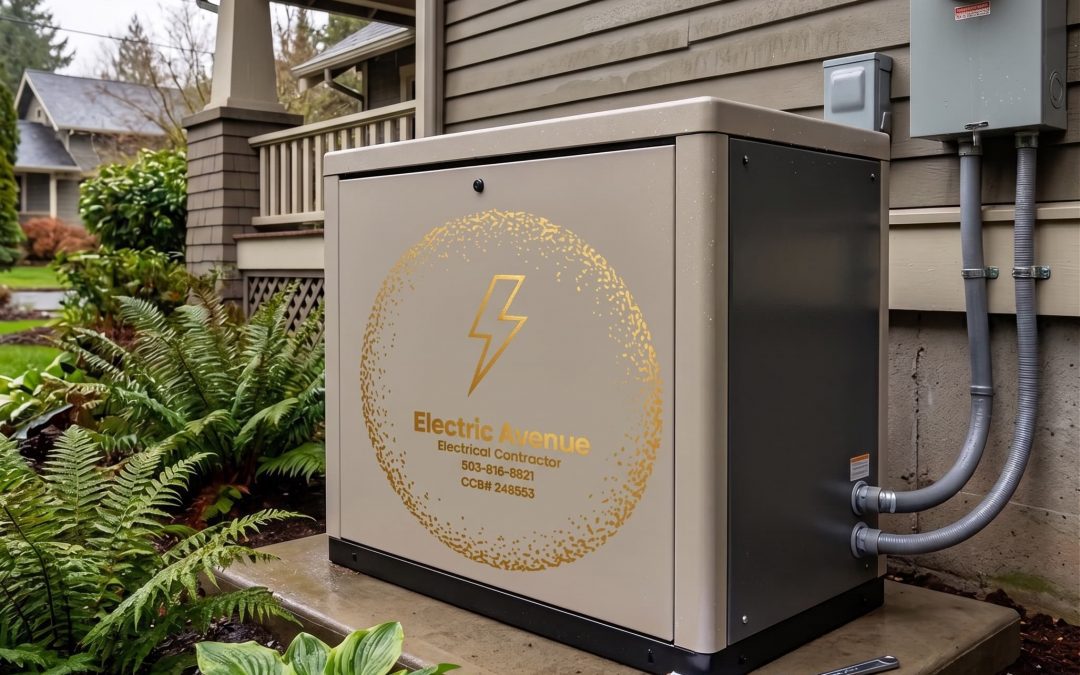
Whole home standby generator installation in Portland typically costs $8,500–$12,500 for a 14–18 kW system — the size that covers most Portland homes — with larger systems running $10,500–$14,800 and up. What drives the final number isn’t the generator itself; it’s how far your gas line needs to run, whether your electrical panel needs upgrading (common in pre-1980 Portland homes), and Portland BDS permit requirements that add time and cost regardless of project size.
Electric Avenue PNW (CCB# 248553) installs standby generators across the Portland metro — Multnomah, Clackamas, and Washington counties. This guide covers real cost ranges, what the permit process looks like, Portland-specific installation constraints, and what homeowners in older Portland homes need to know before getting a quote.
How Much Does Generator Installation Cost in Portland?
Installed cost is primarily a function of generator size (kW output), gas line complexity, and panel condition. The ranges below reflect total installed project cost — unit, automatic transfer switch, labor, gas line, and permits — for a typical Portland single-family home on NW Natural gas service.
These ranges reflect typical Portland installations. Every home is different — gas line distance, panel age, lot constraints, and permit complexity all affect the final number. A free site assessment is the only way to get an accurate figure for your specific property.
| Generator Size | Typical Application | Installed Cost (Portland) |
|---|---|---|
| 10 kW | Essential circuits only — refrigerator, basic lighting, communications, single heat zone | $6,800–$8,200 |
| 14–18 kW | Most Portland homes — HVAC, water heater, core appliances, full lighting | $8,500–$10,500 |
| 20–24 kW | Larger homes, multiple HVAC zones, electric ranges, home offices | $10,500–$12,500 |
| 26–32 kW | Large homes with heavy sustained loads, outbuildings, EV chargers | $12,000–$14,800+ |
| 36 kW+ | Estate/commercial-grade loads | $15,100–$20,500+ |
What’s not included in these ranges: electrical panel upgrades if needed (see Portland panel upgrade costs), knob and tube rewiring in pre-1940 homes, landscape restoration after gas line trenching, and NW Natural meter upgrades if your existing meter can’t support the added load.
What Does the Installation Cost Break Down Into?
Understanding where the money goes helps you evaluate quotes and understand why two identical-kW generators can cost $3,000 more at one property than another.
| Cost Component | % of Total | Notes |
|---|---|---|
| Generator unit & enclosure | 40–50% | Varies by brand (Generac vs. Kohler) and kW output |
| Automatic transfer switch (ATS) | 10–15% | Typically $800–$1,500 for a 200A service-rated smart switch |
| Electrical labor & materials | 20–25% | ATS integration, high-gauge wiring, conduit, concrete pad |
| Gas fitting & line work | 10–20% | Biggest variable — depends on distance from meter to generator |
| Portland BDS permits | 5–10% | Electrical + mechanical + plumbing permits; 12% Oregon state surcharge applies |
The gas line is the most unpredictable cost. Older Portland homes are often plumbed with half-inch black iron pipe that can’t supply enough gas volume to a 20+ kW generator, requiring a dedicated 3/4-inch or 1-inch line run from the meter. If the meter is on the opposite side of the house from the only compliant placement spot — which happens frequently on small R5 and R7 lots — that trench run adds up quickly.
Generac vs. Kohler vs. Briggs & Stratton
Generac
Generac holds approximately 70% of the residential standby market nationally and has the deepest dealer and parts network in the Pacific Northwest. Their RhinoCoat aluminum enclosures handle Portland’s damp, high-precipitation climate well. For most Portland homeowners, Generac is the reliable default — strong availability, known service network, parts in stock locally.
Kohler
Kohler is the premium tier. Commercial-grade engineering, liquid-cooled engines on larger units, and exceptionally clean power output (under 1% total harmonic distortion) make Kohler the right call for homes with sensitive electronics, complex smart home systems, or variable-speed HVAC equipment. Expect a meaningful price premium over Generac for equivalent kW output.
Briggs & Stratton
The value play. Briggs & Stratton has aggressively rebuilt its market positioning and offers competitive pricing with strong extended warranties. Worth considering if budget is the primary constraint — but verify local service coverage in the Portland area before committing, since the dealer network is thinner than Generac’s.
Standby Generator vs. Portable Generator vs. Whole Home Battery
| Option | Upfront Cost | Pros | Cons |
|---|---|---|---|
| Portable generator | $250–$1,000 | Low cost, moveable | Manual setup in a storm, liquid fuel dependent, CO risk, limited runtime |
| Standby generator (natural gas) | $6,800–$14,800+ | Automatic, runs indefinitely on piped gas, powers whole home | High upfront cost, permit process, gas line required |
| Whole home battery + solar | $15,000–$30,000+ | Silent, no fuel, utility rebates available | Limited to 1–2 days without solar recharge, Portland winters limit solar input |
For Portland’s outage profile — multi-day Gorge windstorms and winter ice storms that knock out power for 3–5 days — battery backup runs out before the grid comes back. Natural gas standby generators run as long as the gas is flowing, which makes them the practical choice for whole-home resilience here. Battery systems make more sense in shorter, sunnier outage environments where solar recharge is reliable.
PGE customers in Tier 2 or Tier 3 High Fire-Threat Districts may qualify for a free backup power transfer meter, allowing safe portable generator connection directly to the utility meter — a lower-cost partial solution worth knowing about before committing to a full standby installation.
Portland-Specific Generator Installation Considerations
BDS Permit Requirements
Any permanent standby generator installation in Portland requires three separate permits through Portland Bureau of Development Services (BDS): an electrical permit, a mechanical permit for the exhaust system, and a plumbing permit for the gas line. Oregon adds a 12% state surcharge on top of all base permit fees. Plan review runs 5–14 business days after application. From quote approval to a live, inspected system, expect 4–8 weeks total — the permit queue is the bottleneck, not the physical installation, which takes 2–3 days on site.
Unpermitted generator installations are a material defect under Oregon real estate disclosure law and will surface on home inspections. Don’t skip permits to save time.
Placement Constraints: Title 33 Zoning + NFPA Clearance Rules
Portland’s Title 33 planning code prohibits generator placement in the front setback. Side and rear yard placement is allowed but subject to a 5-foot maximum height limit and visual screening requirements from neighboring properties and the street. NFPA 37 separately requires the unit to sit at least 10 feet from any operable window, door, or fresh air intake, and at least 5 feet from combustible exterior walls.
On R5 and R7 lots — the dominant zoning in Portland’s older neighborhoods — these two sets of rules combined frequently leave very few viable placement locations. This is why a site assessment matters before you order equipment. Lot constraints determine where the generator can legally go, which determines how long the gas line needs to be and what the project actually costs.
NW Natural Gas Service
The overwhelming majority of Portland standby generators run on NW Natural piped gas. A 22 kW unit can draw over 300,000 BTU per hour at full load — significantly more than a typical home’s existing gas demand. NW Natural requires advance notice of the added load and will assess whether your meter needs upgrading. A meter upgrade costs a flat $200. If the underground service line itself is undersized, that cost is variable and can be substantially more.
Many older Portland homes are plumbed with half-inch black iron pipe, which can’t support a 20+ kW generator over distances greater than 20–30 feet. A dedicated 3/4-inch or 1-inch gas line run from the meter to the generator is often required — a meaningful line item in the final project cost.
Older Homes: Panel Upgrades and Knob and Tube Wiring
The Automatic Transfer Switch integrates directly with your main electrical panel. In pre-1980 Portland homes — Craftsman bungalows in Laurelhurst, postwar construction in Sellwood, mid-century homes in Lake Oswego and Beaverton — that panel is often a 60-amp or 100-amp fuse box that can’t support a generator without being upgraded first. Plan for a panel upgrade to 200 amps as part of the scope if your home is pre-1980 and hasn’t had one.
If your home has knob and tube wiring, a generator installation will require addressing the wiring first. Electrical inspectors won’t approve an ATS installation on an ungrounded K&T system. In any pre-1940 Portland home, budget for rewiring as a prerequisite — scope it at the same time as the generator quote so there are no surprises mid-project.
Jack’s Expert Take
“The two things that catch people off guard are the permit timeline and the gas line cost. Everyone focuses on the generator price — and it is the biggest line item — but then they find out the gas line needs a dedicated run across the backyard because the only code-compliant placement spot is 40 feet from the meter, and that adds $1,500 to $3,000 they didn’t plan for. The other thing I flag on every pre-1980 home: ask about the panel on day one. I’ve had homeowners approve a generator project and then we get to the ATS installation and find a 60-amp fuse box that we can’t legally connect to. A site assessment costs nothing and it solves all of this before anyone commits to anything.”
— Jack, Master Electrician | Electric Avenue PNW | CCB# 248553
How Long Does Generator Installation Take in Portland?
| Phase | Timeline |
|---|---|
| Free site assessment | 1–2 hours on site |
| Equipment ordering (if not in stock) | 1–3 weeks depending on unit and brand |
| BDS permit application and filing | 3–5 days |
| BDS plan review | 5–14 business days |
| Physical installation (electrical, gas line, pad, commissioning) | 2–3 days on site |
| BDS final inspection | Within 1 week of completion |
| Total — quote approval to live system | 4–8 weeks typical |
Frequently Asked Questions About Generator Installation in Portland
How much does generator installation cost in Portland?
Total installed cost for a whole home standby generator in Portland ranges from $8,500–$10,500 for a 14–18 kW system covering most homes, to $10,500–$14,800+ for larger 20–32 kW units. This includes the generator unit, automatic transfer switch, electrical labor, gas line work, and all required BDS permits. Panel upgrades and extended gas line runs are additional costs not included in base ranges.
Do I need a permit to install a generator in Portland?
Yes — three permits, in fact. Portland BDS requires an electrical permit, mechanical permit, and plumbing permit for any permanent standby generator installation. Oregon Revised Statute 479 mandates a licensed electrician for all circuit work. Unpermitted installations are a material defect under Oregon real estate disclosure law and will be flagged on home inspection. The permit review process is the primary reason installations take 4–8 weeks.
How far does a generator need to be from the house in Portland?
NFPA 37 requires at least 10 feet from any operable window, door, or fresh air intake, and at least 5 feet from combustible exterior walls. Portland Title 33 zoning additionally prohibits placement in the front setback and requires visual screening from neighbors and the public right-of-way when placed in side or rear setbacks. On smaller Portland lots these rules combined leave very limited placement options, which drives gas line length and project cost.
What size generator do I need for my Portland home?
A 14–18 kW unit covers most Portland single-family homes — whole-home HVAC, water heater, refrigerator, lighting, and standard appliances. Larger homes with multiple HVAC zones, electric ranges, or EV chargers typically need 20–24 kW. Proper sizing requires a load calculation from a licensed electrician during a site assessment. Oversizing wastes money; undersizing means the generator sheds load or bogs down under heavy use.
Is a whole home generator worth it in Portland?
For homeowners who have experienced multi-day outages from Gorge windstorms or winter ice storms — or who work from home, rely on medical equipment, or heat with an electric heat pump — the answer is usually yes. Unlike battery systems that deplete in 1–2 days, natural gas standby generators run as long as gas flows. Portland’s outage profile favors standby gas over battery backup for multi-day whole-home resilience.
Can I install a generator if my home has knob and tube wiring?
Not without addressing the wiring first. The Automatic Transfer Switch must integrate with your main panel, and inspectors won’t approve modern ATS equipment connected to an ungrounded knob and tube system. A generator project in a pre-1940 Portland home almost always requires a panel upgrade and at minimum a partial rewire as prerequisites. Scope both together — it’s more efficient than two separate projects and a single permit process covers more of the scope.
Does Pacific Power or PGE offer rebates for generator installation?
Pacific Power’s Backup Electric Power Rebate (BEPR) program, launched January 2026, provides up to $1,000 toward backup power equipment — including standby generators — for qualifying low-income or medically dependent customers. PGE offers a free backup power transfer meter to residential customers in Tier 2 and Tier 3 High Fire-Threat Districts. Standard residential customers without medical or income qualifications do not currently have utility rebate programs for standby generator installation. Verify current eligibility directly with your utility before budgeting on incentives.
Get a Free Generator Assessment in Portland
If you’re considering a standby generator — whether you’ve had one outage too many this winter or you’re planning ahead — start with a free site assessment. Electric Avenue PNW evaluates your lot constraints, gas line situation, panel condition, and load requirements before any equipment is ordered. You’ll know exactly what the project costs and what’s involved before committing to anything.
Call or text (503) 383-9325, or request a free assessment online. We serve all of Multnomah, Clackamas, and Washington counties — from Northeast Portland to Lake Oswego, Beaverton to Gresham. Licensed Master Electrician, CCB# 248553. Verify our license at the Oregon CCB license lookup.