

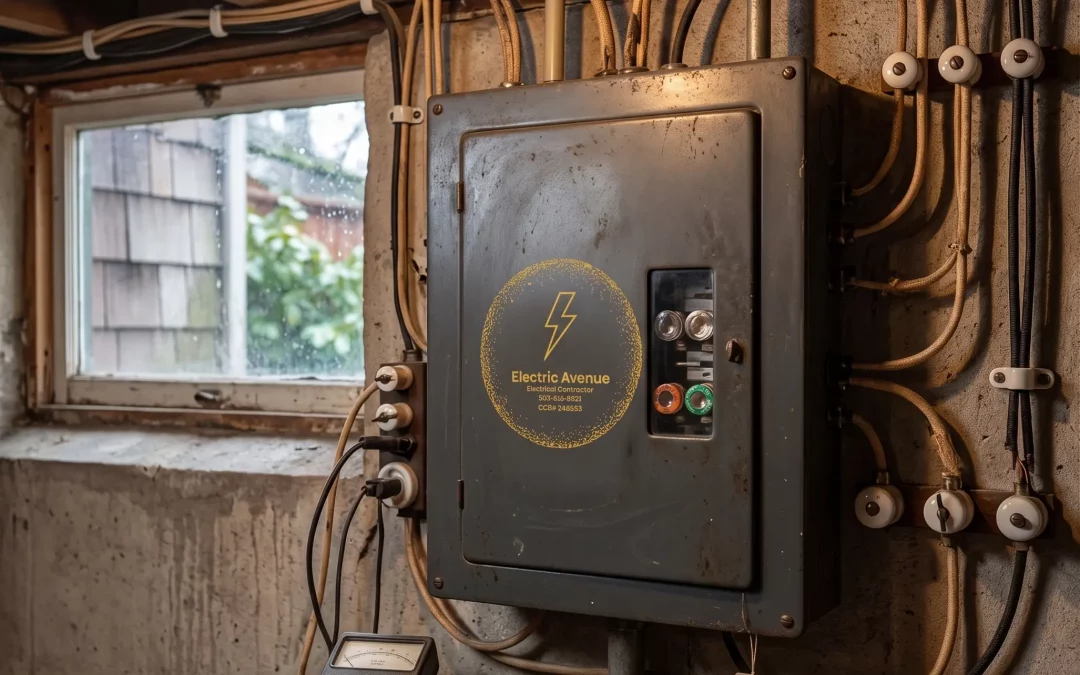
Portland homeowners rewiring a knob and tube home typically pay $8,000 to $15,000 for a full house rewire, with the final number driven by square footage, wall accessibility, and whether the electrical panel needs upgrading at the same time, which it usually does. Knob and tube is not automatically a fire hazard if it is in original condition and not overloaded. The practical reality is different: insurance carriers will not cover it, lenders will not close on it, and renovation work triggers mandatory upgrades.
We have rewired homes across Portland’s older housing stock, from Craftsman bungalows in Laurelhurst to postwar construction in Sellwood and early-1900s homes in Irvington and Alberta Arts. Here is what actually drives the cost, what the insurance situation really looks like, and what to expect from the process.
How much does knob and tube rewiring cost in Portland?
A full rewire runs $8,000 to $15,000 for a typical 1,000 to 1,800 square foot home, and labor is most of it. Wall accessibility is the single biggest variable. Open stud walls in an unfinished basement or attic barely move the number. Finished plaster in a 1920s Craftsman means fishing wire through walls, which adds time and patching to the scope.
| Scope | Typical cost | Notes |
|---|---|---|
| Partial rewire, one room or specific circuits | $1,500 to $4,000 | Common when a kitchen or bath remodel triggers a code upgrade. |
| Single floor rewire | $4,000 to $7,000 | Typical when only one level still has active knob and tube. |
| Full house, 1,000 to 1,500 sq ft | $8,000 to $12,000 | Where most Portland Craftsman bungalows land. |
| Full house, 1,500 to 2,500 sq ft | $10,000 to $15,000 | More circuits, longer runs, more complex routing. |
| Full rewire plus 200A panel upgrade | $12,000 to $18,000 | Most knob and tube homes have 60 to 100 amp panels that need upgrading anyway. |
Not included in those ranges: drywall or plaster repair after fishing wire, attic insulation removal and replacement to safely access the runs, smoke detector upgrades required by Oregon code, and any GFCI or AFCI breakers on rewired circuits.
Plenty of Portland homes were partially rewired at some point, and only one floor or a handful of circuits still carry knob and tube. That changes the scope and the cost substantially. Before anyone quotes you a whole-house number, the circuits should be traced so you know what you actually have.
What is knob and tube wiring?
Knob and tube is an early wiring method used from roughly the 1880s through the 1940s. It is named for the ceramic knobs that anchor wires to framing and the ceramic tubes that protect wire passing through joists. It runs two conductors, a hot and a neutral, with no ground wire.
In original condition it was a sensible system for the loads of its era. The problems come from what happened to it over the following century:
- Insulation deterioration. The rubberized insulation goes brittle and cracks with age, especially in attics that swing between hot and cold. Cracked insulation means exposed conductors.
- Amateur modifications. Decades of owners and unlicensed help splicing modern wire into knob and tube circuits, often with no junction box. Those splices are a known failure point.
- Over-fusing. These circuits are rated for 15 amps. If someone swapped the original fuse for a 20 or 30 amp, the wire carries far more current than it was built for without ever tripping.
- Buried in insulation. Knob and tube needs open air to shed heat. When attic insulation got blown in as an energy upgrade, it covered the wiring and trapped that heat.
Is knob and tube dangerous?
In original, undisturbed condition, knob and tube is not automatically a fire hazard. The electrical code does not require removing it just because it exists. The danger is in what typically happens across 80 to 100 years: deteriorated insulation, amateur splices, over-fusing, and insulation burial are each a real risk on their own. In a Portland home built in 1925, the odds that nobody has touched the wiring are slim.
The honest risk assessment: if your home has knob and tube, assume there are modifications you cannot see. An electrician can trace the circuits, find the splices, check for over-fusing, and tell you whether the insulation is intact. That assessment, not a blanket assumption in either direction, is the right starting point.
A burning smell, flickering lights, or warm outlets and switch plates in a knob and tube home are not a “schedule it next month” problem. See our guide on what counts as an electrical emergency in Portland, or just call us.
Will insurance cover a Portland home with knob and tube?
Most major carriers in Oregon will not write a new policy on a home with active knob and tube, or they will charge significantly more with reduced coverage. This, not code and not safety alone, is what actually forces most rewires in Portland.
- Buying the home. Lenders require proof of insurance to close. If your insurer will not cover it without a rewire, you either rewire before closing or go to a surplus lines carrier at much higher cost and lower limits.
- Renewing an existing policy. Carriers periodically inspect. If an inspection turns up active knob and tube, many give you 30 to 90 days to fix it or they cancel.
- Filing a claim. If there is a fire and the carrier can argue the knob and tube contributed, you may face a denied or reduced claim even if you disclosed it up front. It varies by carrier, but the exposure is real.
Bottom line: if you plan to sell, refinance, or just keep continuous coverage at normal rates, a rewire is not really optional in most Portland situations.
Insurance giving you a deadline?
We trace the circuits, document the scope, and give you a real number, fast.
Portland-specific realities
Which neighborhoods are most affected
Portland’s knob and tube homes cluster in neighborhoods built before 1940. Even if previous owners rewired part of the house, original wiring often survives in attics, basements, and interior walls that were never opened.
High-concentration areas: Laurelhurst, Irvington, Alameda, Grant Park, Concordia, Alberta Arts, St. Johns, Kenton, Sellwood, Woodstock, Hawthorne, Buckman, Sunnyside, and parts of Northwest Portland. Older Lake Oswego and parts of West Linn have significant pre-1940 stock too.
Permits and the renovation trigger
Rewiring in Portland requires an electrical permit through Portland Permitting & Development, and Oregon law (ORS 479) requires a licensed electrician for new circuit work. A full rewire involves load calculations, a wiring plan, plan review, installation, and final inspection.
The part that catches people off guard is the renovation trigger. Pull a permit for a kitchen remodel or bathroom addition, and the jurisdiction may require the affected circuits, sometimes more, to be brought up to current code. That is how a planned remodel quietly becomes a partial rewire. A licensed electrician can tell you which triggers apply before you commit.
The panel is usually part of the job
Knob and tube homes almost always still have their original service: 60 or 100 amp fuse boxes that are undersized for modern life. A rewire adds circuits a 60 amp panel simply cannot carry, so most projects include a panel upgrade to 200 amps. Plan for it from the start instead of discovering it mid-project.
One thing worth knowing: Oregon did not adopt the 2023 code’s outdoor emergency disconnect rule (NEC 230.85), so it is not required on a panel replacement here. Washington did adopt it, so the same job in Vancouver or Camas includes one.
How long does a rewire take?
| Phase | Timeline |
|---|---|
| Site assessment | 1 to 2 hours on site |
| Permit application and filing | 3 to 5 days |
| Plan review | 5 to 14 business days |
| Rewiring, partial or single floor | 1 to 3 days |
| Rewiring, full house | 3 to 7 days depending on size and wall access |
| Final inspection | Within a week of completion |
Wall repair is a separate scope that happens after the electrical passes inspection. Budget time and money for that phase when you plan the project.
Frequently asked questions
How much does it cost to rewire a knob and tube house in Portland?
A full rewire for a typical Portland Craftsman of 1,000 to 1,800 square feet runs $8,000 to $15,000. Homes that also need a panel upgrade, which is most knob and tube homes, should budget $12,000 to $18,000 for the combined scope. Partial rewires for a room or a few circuits run $1,500 to $4,000. A site assessment is the only way to get a real number.
Is knob and tube wiring illegal in Portland?
No. It is not prohibited simply because it exists. It cannot legally be extended or modified, and renovation work that triggers a permit may require bringing affected circuits up to current code. The practical barriers, insurance and lender requirements, are what force most rewires here, not a code mandate.
Will homeowners insurance cover a house with knob and tube?
Most standard carriers will not write new policies on homes with active knob and tube, or they add exclusions and charge more. Existing policyholders can get cancellation notices after an inspection finds it. This is the most common reason Portland homeowners move forward with a rewire.
Do I need a permit to rewire knob and tube in Portland?
Yes. Oregon law (ORS 479) requires a licensed electrician and an electrical permit for new circuit work. The permit covers plan review and inspection, and it creates the official record that satisfies insurers and lenders. Unpermitted rewiring is a material defect under Oregon real estate disclosure law.
Can knob and tube be repaired instead of fully replaced?
Individual circuits can sometimes be repaired or partially replaced, and occasionally that is the right call. An electrician can assess which circuits are acceptable and which need replacing. What cannot be fixed short of replacement is the lack of a ground wire, which matters for modern appliances and means no three-prong outlets without GFCI protection.
Is aluminum wiring the same problem as knob and tube?
No, they are separate issues. Knob and tube (1880s to 1940s) uses copper. Aluminum branch wiring showed up in homes built roughly 1965 to 1973 when copper prices spiked. Aluminum expands and contracts more than copper, so connections loosen and heat up. Both need a licensed electrician, but the fix differs. Aluminum often gets remediated with approved connectors at connection points rather than a full rewire.
How do I know if my Portland home has knob and tube?
The reliable way is a look in the attic and basement. It is identifiable by the ceramic knobs anchoring wires to framing and the ceramic tubes where wires pass through joists. Homes built before 1940 are the highest-probability candidates. If you cannot safely get into those spaces, an electrician can trace the circuits during a site assessment. You can verify any contractor’s license at the Oregon CCB lookup.
Find out what you actually have.
If your Portland home predates 1940 and you are facing insurance questions, a planned remodel, or just want to know what is in your walls, start with an assessment. We trace the circuits, identify what genuinely needs replacing, and give you a specific number before any work starts. No pressure, no upsell. Licensed in Oregon (CCB# 248553) and Washington (ELECTAP741JB), with 250+ five-star reviews.